

If X 0 Then X
IF Function
Tests a given condition and returns 1 value for a Truthful result, and another for a Imitation issue
What is an Excel IF Argument?
The Excel IF Statement tests a given condition and returns one value for a Truthful effect and another value for a Simulated result. For case, if sales full more than $v,000, so return a "Yeah" for Bonus – Otherwise, render a "No" for Bonus. Nosotros can also use the IF role to evaluate a single part, or we tin can include several IF functions in ane formula. Multiple IF statements in Excel are known as nested IF statements.
As a financial analyst, the IF role is used often to evaluate and analyze data past evaluating specific conditions.
The function tin be used to evaluate text, values, and fifty-fifty errors. It is not limited to only checking if i matter is equal to another and returning a unmarried result. Nosotros can also use mathematical operators and perform additional calculations, depending on our criteria. We can also nest multiple IF functions together to perform multiple comparisons.
IF Formula
=IF(logical_test, value_if_true, value_if_false)
The part uses the following arguments:
- Logical_test (required argument) – This is the condition to exist tested and evaluated as either TRUE or FALSE.
- Value_if_true (optional argument) – The value that will be returned if the logical_test evaluates to True.
- Value_if_false (optional argument) – The value that will be returned if the logical_test evaluates to FALSE.
When using the IF function to construct a test, nosotros can use the post-obit logical operators:
- = (equal to)
- > (greater than)
- >= (greater than or equal to)
- < (less than)
- <= (less than or equal to)
- <> (not equal to)
How to use the Excel IF Part
To sympathise the uses of the Excel IF argument function, allow'south consider a few examples:
Example 1 – Unproblematic Excel IF Statement
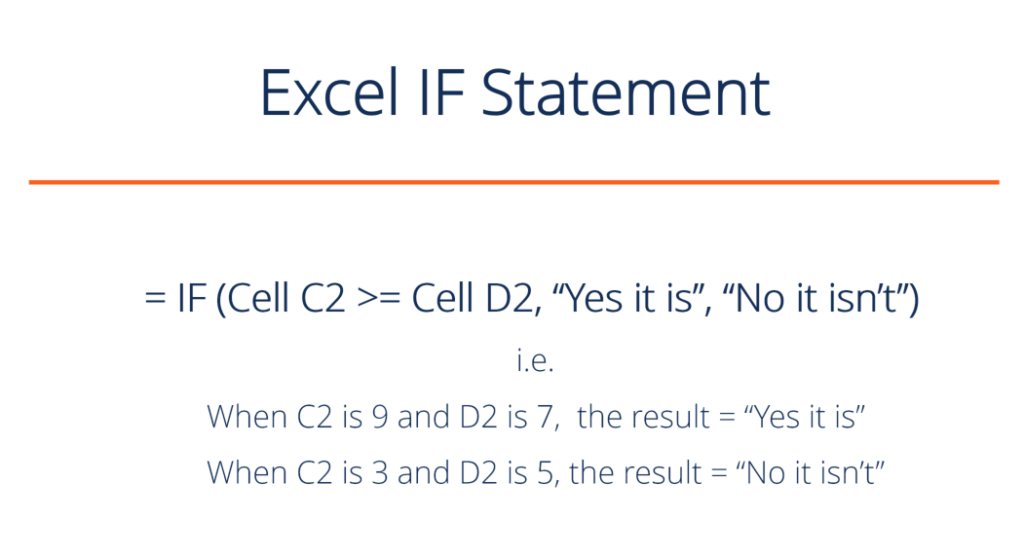
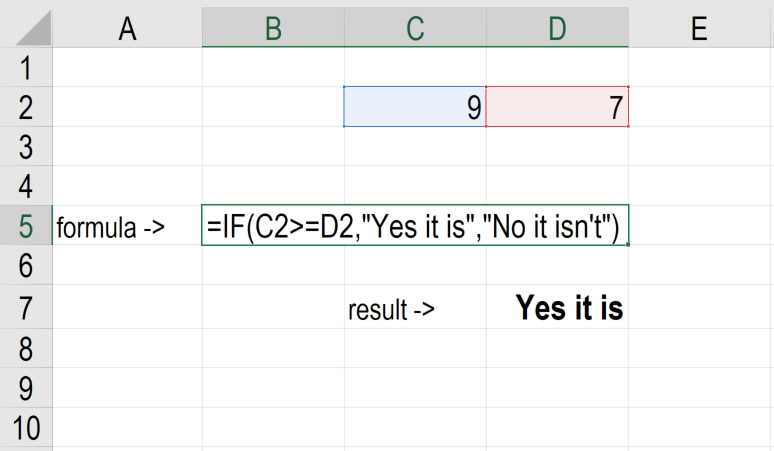
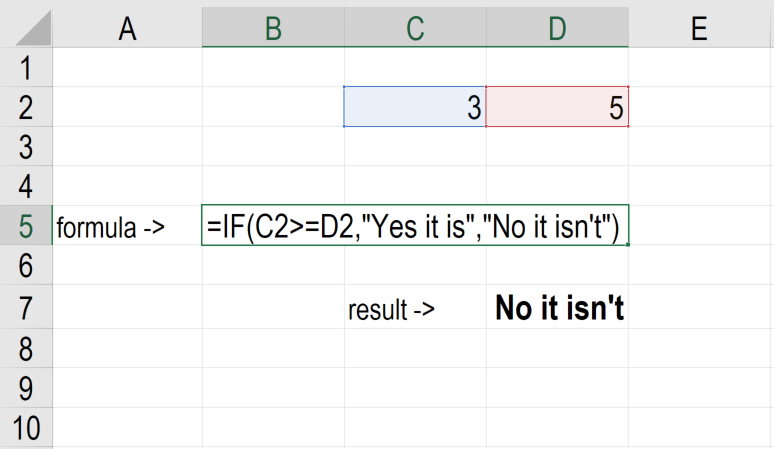
Suppose we wish to practise a very simple test. We desire to test if the value in cell C2 is greater than or equal to the value in cell D2. If the argument is true, then we want to return some text stating "Yes information technology is", and if it'due south not true, then nosotros want to display "No it isn't".
You can come across exactly how the Excel IF statement works in the unproblematic example below.
Consequence when true:
Event when false:
Download the simple XLS template.
Example 2 – Excel IF Argument
Suppose we wish to test a jail cell and ensure that an activeness is taken if the cell is non blank. Nosotros are given the data below:
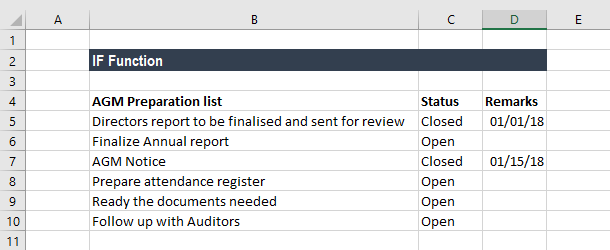
In the worksheet above, we listed AGM-related tasks in Column A. Remarks comprise the date of completion. In Column B, nosotros will apply a formula to cheque if the cells in Cavalcade C are empty or non. If a cell is blank, the formula will assign the status "open." However, if a cell contains a appointment, then the formula will assign a status of "airtight." The formula used is:
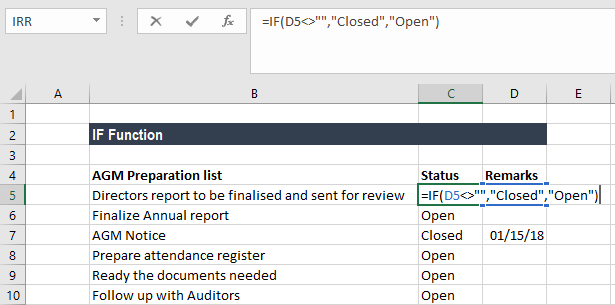
We get the results below:
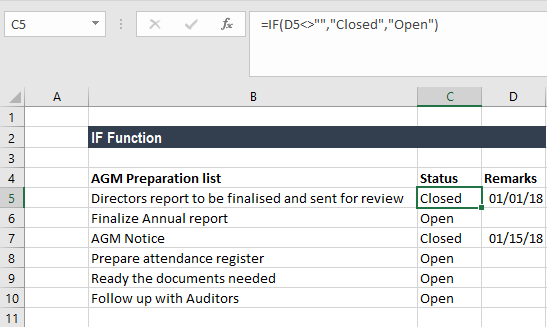
Example 3 – Excel IF Statement
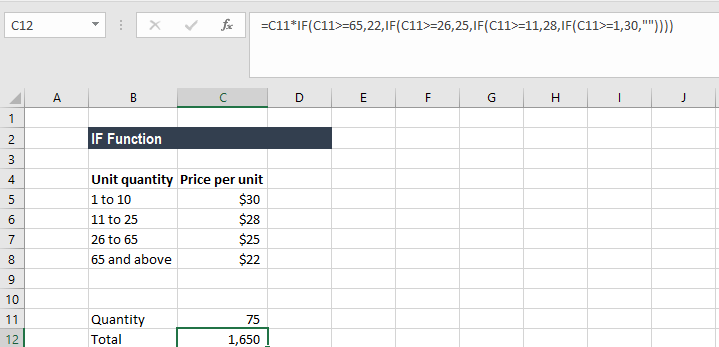
Sellers frequently provide a discount based on the quantity purchased. Suppose we are given the post-obit data:
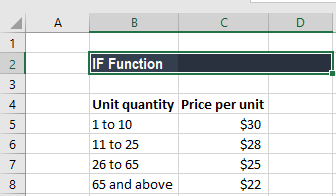
Using multiple IF functions, nosotros can create a formula to cheque multiple conditions and perform different calculations depending on what amount range the specified quantity falls in. To calculate the total price for 100 items, the formula volition be:
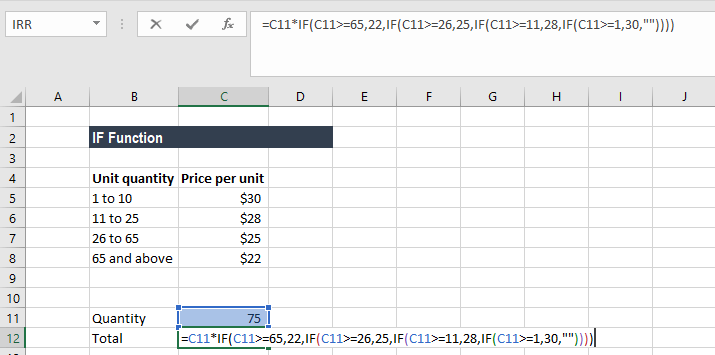
Nosotros get the result below:
Things to think well-nigh the IF Function
- The Excel IF part volition work if the logical_test returns a numeric value. In such a case, any non-null value is treated as True and zilch is treated as Simulated.
- #VALUE! error – Occurs when the given logical_test statement cannot be evaluated equally TRUE or FALSE.
- When any of the arguments are provided to the office as arrays, the IF function will evaluate every chemical element of the array.
- If nosotros wish to count conditions, we should apply the COUNTIF and COUNTIFS functions.
- If we wish to add upwardly conditions, we should utilize the SUMIF and SUMIFS functions.
Reasons to use an Excel IF Argument
There are many reasons why an annotator or anyone who uses Excel would want to build IF formulas.
Common examples include:
- To examination if an argument is true or false
- To output a NUMBER
- To output some TEXT
- To generate a conditional formula (eastward.grand., the outcome is C3+B4 if true and N9-E5 if simulated)
- To create scenarios to be used in financial modeling
- To calculate a debt schedule or a fixed nugget depreciation schedule in accounting
Click here to download the sample Excel file
Additional resources
Thanks for reading CFI's guide on how to use an Excel IF Argument. By taking the time to acquire and master these functions, you'll significantly speed up your financial analysis. To learn more than, bank check out these additional CFI resource:
- Complimentary Excel Fundamentals Course
- Avant-garde Excel Course
- Avant-garde Excel Formulas Guide
- Excel Shortcuts List
- Financial Modeling Program

If X 0 Then X,
Source: https://corporatefinanceinstitute.com/resources/excel/excel-if-statement-guide/
Posted by: malonetheried.blogspot.com
0 Response to "If X 0 Then X"
Post a Comment