

Do License Plate Camera Readers Issue Tickets?
Automatic license plate readers (ALPRs) are loftier-speed, computer-controlled camera systems that are typically mounted on street poles, streetlights, highway overpasses, mobile trailers, or fastened to police squad cars. ALPRs automatically capture all license plate numbers that come into view, along with the location, date, and fourth dimension. The data, which includes photographs of the vehicle and sometimes its driver and passengers, is and then uploaded to a cardinal server.
Vendors say that the information collected tin exist used past police to find out where a plate has been in the past, to decide whether a vehicle was at the scene of a crime, to place travel patterns, and even to observe vehicles that may be associated with each other. Law enforcement agencies can choose to share their data with thousands of other agencies.
Taken in the aggregate, ALPR data can paint an intimate portrait of a driver's life and fifty-fifty arctic First Amendment protected activity. ALPR technology tin can be used to target drivers who visit sensitive places such equally wellness centers, immigration clinics, gun shops, union halls, protests, or centers of religious worship.
Drivers have no control over whether their vehicle displays a license plate because the government requires all car, truck, and motorcycle drivers to display license plates in public view. Then information technology'due south particularly disturbing that automated license plate readers are used to rails and tape the movements of millions of ordinary people, even though the overwhelming bulk are non connected to a crime.
How ALPRs Work
Automated license plate readers can be broadly divided into ii categories.
Stationary ALPR cameras
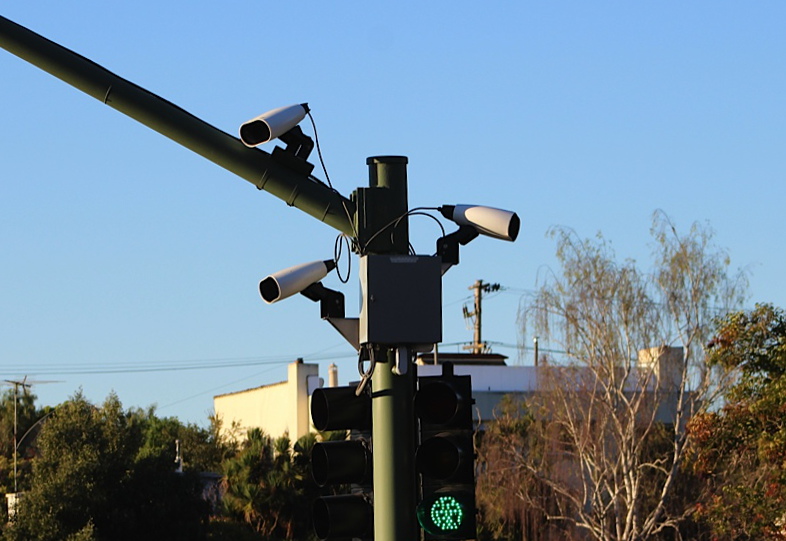
Photo by Mike Katz-Lacabe (CC BY)
These are installed in a fixed location, such equally a traffic light, a phone pole, the entrance of a facility, or a freeway go out ramp. These cameras generally capture only vehicles in motion that laissez passer within view.
If multiple stationary ALPR cameras are installed along a unmarried thoroughfare, the data tin reveal what direction and what speed a motorcar is traveling. If the data are stored over fourth dimension, they can reveal every time a particular plate has passed a given location, allowing the authorities to infer that the driver likely lives or works shut by.
Stationary cameras tin sometimes be moved. For example, surveillance vans or truck trailers can be outfitted with ALPR systems and so parked at strategic locations, such as gun shows or political rallies.
ALPR cameras are often used in conjunction with automated red-calorie-free and speed enforcement systems, and as well as a means of assessing tolls on roads and bridges.
Mobile ALPR cameras
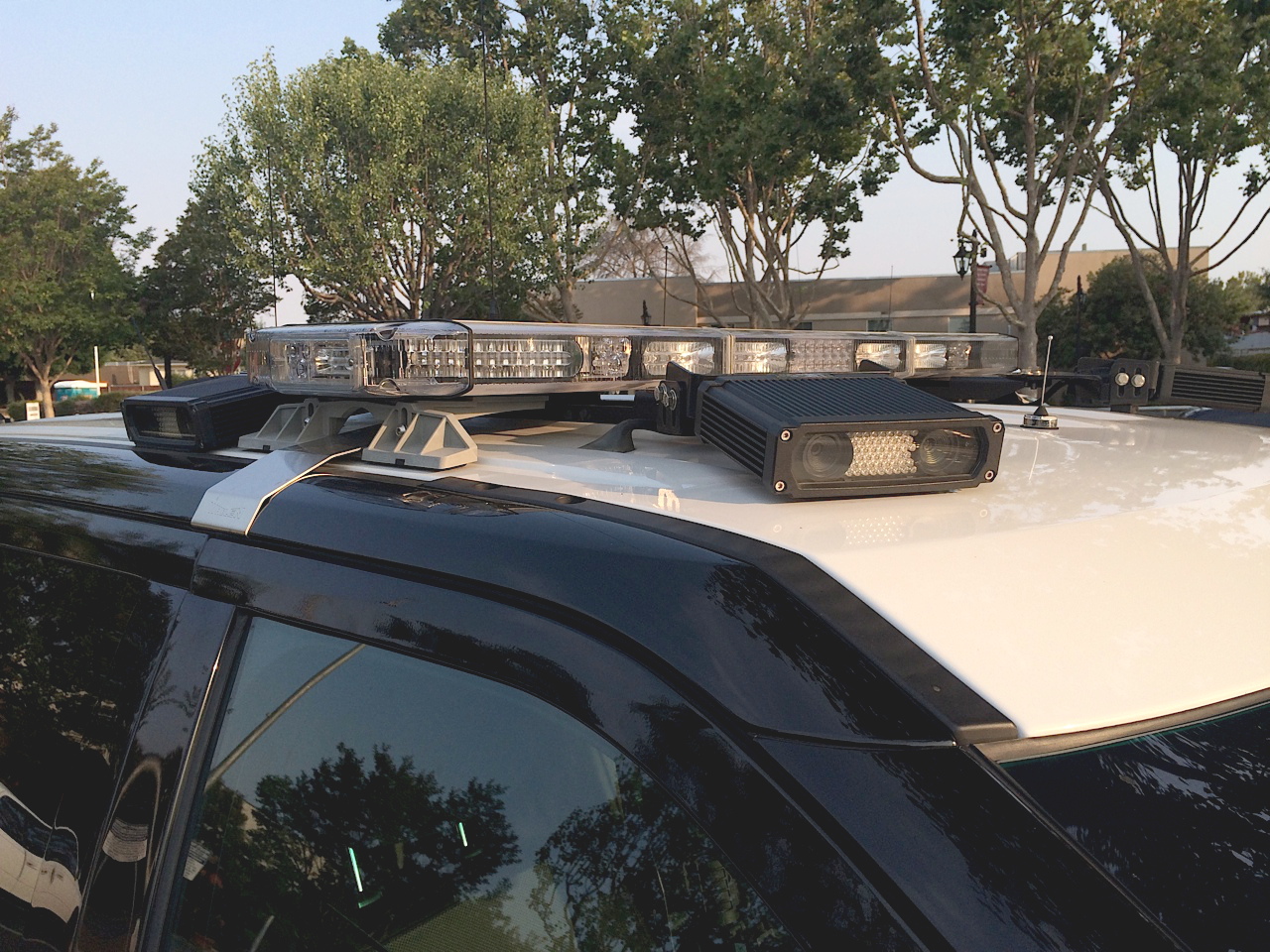
Photo by Mike Katz-Lacabe (CC BY)
These are often attached to police patrol cars, allowing law enforcement officers to capture data from license plates as they drive effectually the city throughout their shifts. In near cases, these cameras are turned on at the beginning of a shift and not turned off once again until the end of the shift. As well, private vendors like Vigilant Solutions capture plate data with mobile ALPRs and then sell that data to police agencies and others.
In add-on to capturing images of passing vehicles, mobile ALPR cameras are constructive at capturing license plates of parked cars. For case, a patrol car may drive around a public parking lot capturing hundreds of vehicles' plates in minutes.
ALPR Databases
Near of this ALPR data is stored in databases for extended periods of time—frequently as much as five years. The databases may be maintained past the police departments, but often they are maintained past private companies such every bit Vigilant Technologies. Law enforcement agencies without their own ALPR systems can access data nerveless by other constabulary enforcement agencies through regional sharing systems and networks operated by these individual companies. Several companies operate contained, non-law enforcement ALPR databases, contracting with drivers to put cameras on individual vehicles to collect the data. These data are then sold to companies like insurers, only law enforcement can besides buy access to this commercial data on a subscription basis.
Hotlists
Police force enforcement agencies will ofttimes pre-load a list of license plates that the ALPR organization is actively looking for—such as stolen vehicles and vehicles associated with outstanding warrants. Police force officers can also create their own hotlists. If the ALPR camera scans a plate on the list, the system sends an alert to the officer in the squad car (if it'south a mobile reader) or the agency (if it'due south a stock-still reader). Some hotlists include low-level misdemeanors and traffic offenses. Some agencies use these hotlists to generate revenue past stopping commendation scofflaws.
What Kinds of Information ALPRs Collect
ALPRs collect license plate numbers and location data along with the exact date and time the license plate was encountered. Some systems are able to capture make and model of the vehicle. They tin can collect thousands of plates per infinitesimal. One vendor brags that its dataset includes more than 6.5 billion scans and grows at a rate of 120-1000000 information points each month.
When combined, ALPR data tin can reveal the management and speed a person traveled through triangulation. In aggregate over time, the information can reveal a vehicle'south historical travel. With algorithms applied to the data, the systems can reveal regular travel patterns and predict where a driver may exist in the futurity. The data also reveal all visitors to a detail location.
The information generally does non include the driver's name. However, constabulary enforcement officers can use other databases to connect individual names with their license plate numbers.
In addition to capturing license plate information, the photographs tin reveal images of the vehicle, the vehicle'south drivers and passengers, likewise as its immediate environment—and even people getting in and out of a vehicle. A 2009 privacy impact assessment report indicates that the photographs may even include bumper stickers, which could reveal data on the political or social views of the driver.
How Law Enforcement Uses ALPRs
ALPR data is gathered indiscriminately, collecting information on millions of ordinary people. By plotting vehicle times and locations and tracing past movements, constabulary tin utilize stored information to pigment a very specific portrait of drivers' lives, determining past patterns of behavior and possibly even predicting future ones—in spite of the fact that the vast bulk of people whose license plate data is nerveless and stored have not even been accused of a criminal offense. Without ALPR technology, law enforcement officers must collect license plates by hand. This creates practical limitations on the amount of data that can be collected and means officers must make choices virtually which vehicles they are going to track. ALPR applied science removes those limitations and allows officers to rails everyone, allowing for faster and broader drove of license plates with far reduced staffing requirements.
Law enforcement has 2 general purposes for using license plate readers.
Existent-time investigations
By calculation a license plate to a "hot list," officers tin can apply ALPR to automatically identify or track particular vehicles in real time. Licenses plates are often added to hot lists because the vehicle is stolen or associated with an outstanding warrant. Officers may also add a plate number to the listing if the vehicle has been seen at the scene of a crime, the possessor is a suspect in a crime, or the vehicle is believed to be associated with a gang. Hot lists often include depression-level offenses, besides.
Historical investigations
Since ALPRs typically collect data on everyone—not just hot-listed vehicles—officers tin employ a plate, a partial plate, or a physical address to search and clarify historical data. For instance, an officer may enter the location of a convenience store to identify vehicles seen nearby at the time of a robbery. The officer tin can then look upward those plate numbers to detect other locations that plate has been captured.
Preparation materials, policies and laws in some jurisdictions instruct officers that a hot-list warning on its own may not be plenty to warrant a stop. Officers are instructed to visually ostend that a plate number is a match. Failure to manually confirm, combined with car error, has caused wrongful stops.
Police force enforcement claims that ALPR data has been used to, for example, recover stolen cars or observe abducted children. Notwithstanding, police have likewise used ALPR data for mass enforcement of less serious offenses, such every bit searching for uninsured drivers or tracking down individuals with overdue court fees.
The ACLU estimates that less than 0.2 pct of plate scans are linked to criminal activity or vehicle registration issues. Many law enforcement agencies store ALPR information for years, and share it with other law enforcement agencies and federal agencies.
The length of time that ALPR information is retained varies from agency to agency, from as short as mere days to as long as several years, although some entities—including individual companies—may retain the data indefinitely.
Who Sells ALPR Engineering science
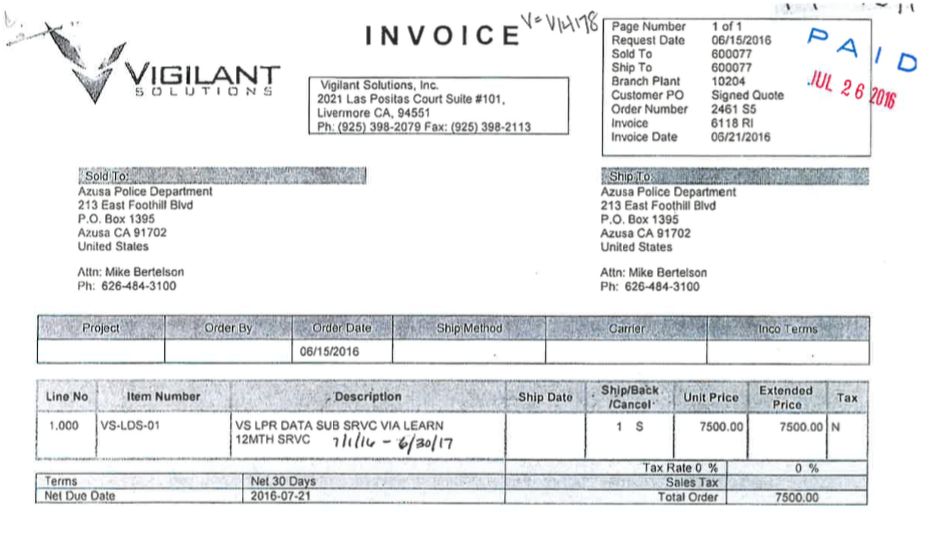
Vigilant Solutions and ELSAG are the largest ALPR vendors.
Vigilant Solutions' subsidiary Digital Recognition Network, along with MVTrac, are the 2 principal companies hiring contractors to collect ALPR data across the country. The companies then share the commercially-collected data non just with police enforcement but besides with car recovery (aka "repo") companies, banks, credit reporting agencies, and insurance companies.Data nerveless by private entities does non have retention limits and is not discipline to sunshine laws, or whatever of the other safeguards that are sometimes found in the authorities sector.
Some jurisdictions use ALPR engineering originally developed by PIPS, which was subsequently sold to 3M. The ALPR partitioning was more recently acquired by Neology, Inc.
Threats Posed by ALPR
ALPR is a powerful surveillance technology that can be used to invade the privacy of individuals as well as to violate the rights of entire communities.
Law enforcement agencies have abused this technology. Police officers in New York collection downwards a street and electronically recorded the license plate numbers of everyone parked near a mosque. Constabulary in Birmingham targeted a Muslim community while misleading the public about the project. ALPR data EFF obtained from the Oakland Police Department showed that police disproportionately deploy ALPR-mounted vehicles in depression-income communities and communities of color.
Moreover, many individual officers have abused police enforcement databases, including license plate information and records held by motor vehicle departments. In 1998, a Washington, D.C. law officer "pleaded guilty to extortion after looking upwards the plates of vehicles near a gay bar and blackmailing the vehicle owners." Police officers have also used databases to search romantic interests in Florida. A former female police officer in Minnesota discovered that her driver's license record was accessed 425 times by 18 different agencies beyond the state.
In addition to deliberate misuse, ALPRs sometimes misread plates, leading to dire consequences. In 2009, San Francisco police pulled over Denise Green, an African-American city worker, handcuffed her at gunpoint, forced her to her knees, and searched both her and her vehicle—all because her motorcar was misidentified as stolen due to a license plate reader error. Her experience led the U.S. Ninth Circuit Courtroom of Appeals to rule that technology lone can't be the footing of such a stop, but that judgment does not apply everywhere, leaving people vulnerable to like constabulary enforcement errors.
Amass information stored for lengthy periods of time (or indefinitely) becomes more invasive and revealing, and it is susceptible to both misuse and data breach. Sensible retentivity limits, specific policies about who inside an bureau is immune to admission information, and audit and control processes could assist minimize these issues. I of the meliorate privacy protections would be for police to retain no information at all when a passing vehicle does not lucifer a hot list.
EFF's Work on ALPR
EFF has been investigating and combating the privacy threats of ALPR technology through public records requests, litigation, and legislative advancement since 2012.
ALPR Litigation
EFF and the ACLU of Southern California sued the Los Angeles Canton Sheriff's Department and the Los Angeles Constabulary Department after the agencies refused to hand over ALPR data. The agencies claimed the records were exempt from the California Public Records Human action because they were investigative records. This argument amounts to claiming that all Los Angelenos are nether investigation, a point that both a lawyer for the LAPD and a California Supreme Court Justice agreed sounded "Orwellian" during oral arguments. In 2017, the California Supreme Court ruled in EFF and ACLU'southward favor and ordered the instance back to the Superior court.
Exterior of California, EFF has filed briefs in a lawsuit over the excessive storage collection of ALPR information in the land of Virginia.
ALPR Accountability and Transparency
In 2015, the California legislature passed South.B. 34, a pecker that requires ALPR users to protect data, maintain access logs, hold public meetings earlier starting an ALPR program, implement a usage and privacy policy, and maintain access logs. The law also prohibits public agencies from selling, sharing, or transferring ALPR data except to other public agencies.
EFF has coordinated volunteers to collect ALPR policies across the state of California and to expose agencies failing to comply with the constabulary. EFF has also independently filed public records requests with dozens of agencies to shine calorie-free on their employ of ALPR data.
ALPR Security
EFF investigated more 100 ALPR cameras operated by police enforcement that were leaking data because of misconfiguration. These cameras were inadvertently publicly accessible through web browsers and Telnet interfaces. After EFF disclosed these vulnerabilities, several agencies in Louisiana and California overhauled their ALPR networks.
We have also contacted public safe agencies whose ALPR data was exposed online, ofttimes on websites attainable to anyone with a web browser, to responsibly disclose the security vulnerabilities we constitute.
EFF Legal Cases
ACLU of Southern California and EFF v. LAPD and LASD
Neal v. Fairfax Canton Police Department
For More Data
Yous Are Being Tracked (ACLU)
License Plate Readers for Police Enforcement Opportunities and Obstacles (RAND Corporation)
Automated License Plate Readers Threaten Our Privacy (EFF/ACLU)
The 4 Flavors of Automated License Plate Reader Technology (EFF)
Most recently updated August 28, 2017
Source: https://www.eff.org/pages/automated-license-plate-readers-alpr
Posted by: malonetheried.blogspot.com
0 Response to "Do License Plate Camera Readers Issue Tickets?"
Post a Comment